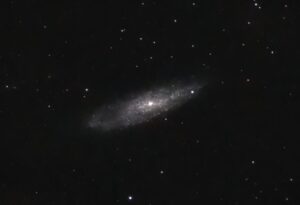
The Claw Galaxy
NGC 247, the Claw Galaxy, sits 11.1 million light-years away in Cetus. Its faint, elongated spiral disk appears uneven — one side scarred by a long-ago event that quenched star formation. Through the Seestar S50 its subtle light spans the sky, a cosmic claw reaching through darkness, relic of shaping forces unseen.
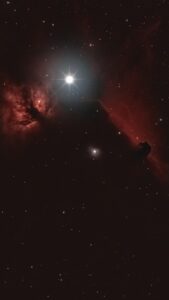
The Horsehead Nebula
IC 434 glows behind the Horsehead Nebula in Orion, 1,375 light-years away. Through the Seestar S50, its red hydrogen light forms a radiant backdrop for the famous dark silhouette. Ionized by Sigma Orionis, this region captures the essence of stellar creation — light and shadow shaping new stars amid cosmic dust.
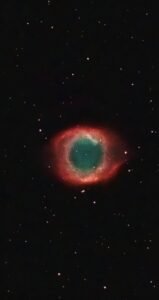
NGC 7293 – Helix Nebula
NGC 7293, the Helix Nebula, lies just 655 light-years away in Aquarius — a vast, glowing eye in space. Through the Seestar S50, its teal and crimson filaments surround a fading white dwarf. This is a Sun’s quiet farewell — stellar death transformed into beauty, its elements recycled into future stars.

NGC 7000 – North American Nebula
NGC 7000, the North America Nebula, glows 2,590 light-years away in Cygnus — a vast red cloud shaped uncannily like our continent. Through the Seestar S50, its hydrogen light reveals a bustling nursery of newborn stars. In this celestial map of light and dust, the galaxy sketches its own geography of creation.

NGC 6992 — The Eastern Veil Nebula
NGC 6992, the Eastern Veil Nebula, lies 2,400 light-years away in Cygnus. Through the Seestar S50, it unfurls as a glowing lattice of hydrogen and oxygen — the lingering breath of a star that died millennia ago. Its filaments trace both devastation and renewal — beauty born from cosmic destruction.

IC 5146 — The Cocoon Nebula
IC 5146, the Cocoon Nebula, glows 3,300 light-years away in Cygnus. Through the Seestar S50, its soft red and blue light reveals newborn stars breaking free from their dusty cradle. At the end of a dark cosmic lane, the Cocoon is a living metaphor — creation emerging from shadow into radiance.
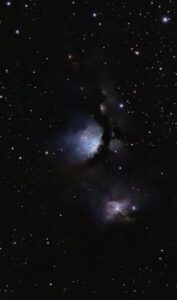
M78 — The Reflection Nebula in Orion
M78, a reflection nebula in Orion, shines 1,350 light-years away as starlight scattered through cosmic dust. Through the Seestar S50, its soft blue glow reveals stars in formation, still shrouded in their birth clouds. M78 is the whisper before the roar — the gentle beginning of stellar creation’s great symphony.

M33
M33, the Triangulum Galaxy, lies 2.7 million light-years away — a near neighbor glowing with stellar birth. Through the Seestar S50, its open spiral arms glisten with pink nebulae and blue clusters. Home to vast regions like NGC 604, M33 is a living galaxy — restless, radiant, and still creating stars.

NGC6888
NGC 6888, the Crescent Nebula, lies 4,700 light-years away in Cygnus. Formed by the fierce winds of a Wolf–Rayet star, its glowing arcs of hydrogen and oxygen shimmer in pink and blue through the Seestar S50. It’s a dying star’s farewell — a fragile crescent sculpted by light, wind, and time.

NGC 6946
NGC 6946, the Fireworks Galaxy, blazes 22 million light-years away between Cepheus and Cygnus. Through the Seestar S50, its spiral arms shimmer with newborn stars and past supernovae — ten recorded in just a century. It’s a galaxy in constant renewal, where stellar life and death weave the luminous tapestry of creation.

C2025 R2
C/2025 R2 (SWAN) edges past Earth this October at ~0.26 AU, its green coma and 2-degree tail visible through binoculars. Discovered in September via SOHO/SWAN, it’s a long-period comet from the outer Solar System, now lighting up our dusk skies—and reminding us how rare and transient such cosmic intruders are.

M27
M27, the Dumbbell Nebula, lies about 1,360 light-years away in Vulpecula. Through the Seestar S50, it glows in turquoise and crimson — the fading breath of a dying star. Its expanding gas shell, shaped like a dumbbell, reminds us that stellar endings are not destruction, but transformation into new cosmic beginnings.

NGC 891
NGC 891, the Silver Sliver Galaxy, lies 30 million light-years away in Andromeda. Seen edge-on, its dark dust lane divides a glowing river of stars — a near twin to our Milky Way. Through the Seestar S50, it reveals a galaxy’s elegant structure, suspended in silent, luminous equilibrium across the cosmos.

Simple Siril Processing of Seestar Images
The Siril workflow involves stacking Seastar S50 data, removing green noise, using Grappert AI for background extraction, and Spectrophotometric color calibration. Stars are removed (StarNet) and the image is stretched using Generalized Hyperbolic Stretch. Final steps include star recomposition and sharpening.

The Sun
The Sun, our nearest star, burns 150 million kilometers away — a vast fusion engine turning hydrogen into light and life. Captured with the Seestar S50, its shifting sunspots and fiery prominences reveal a dynamic star in constant motion, the heartbeat of our solar system and the source of all warmth.