

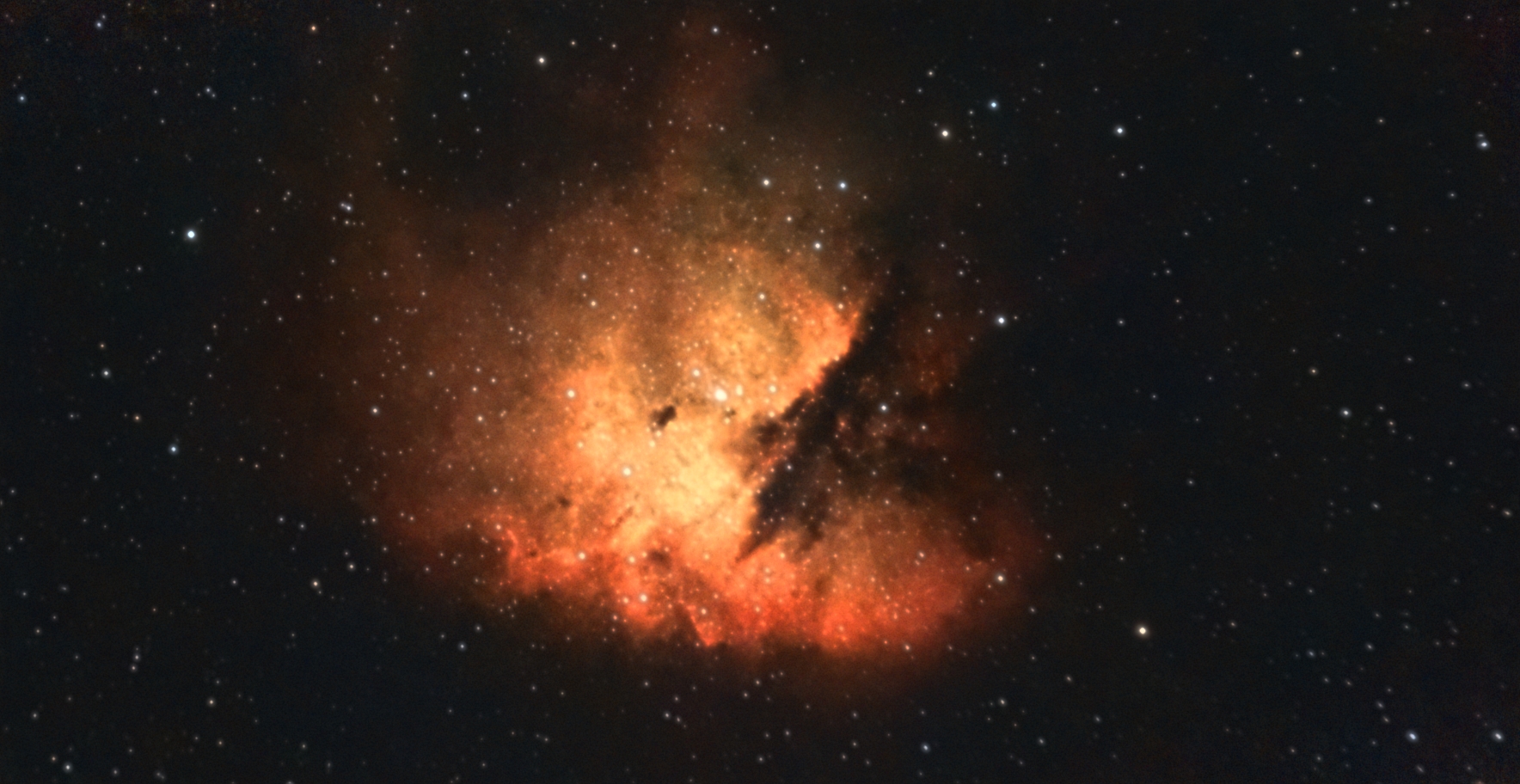
NGC 281 — The Pacman Nebula
Captured with: Seestar S50 Smart Telescope
Distance: ~9,200 light-years
Constellation: Cassiopeia
Type: Emission Nebula / Star-Forming Region
Apparent Size: ~35 × 30 arcminutes
The Pacman Nebula is a bright emission nebula glowing with the light of ionized hydrogen, shaped by the energetic young stars of the IC 1590 cluster at its heart. The ultraviolet radiation from these stars excites the surrounding gas, causing it to emit the rich red light seen in long-exposure astrophotography.
Through the Seestar S50, NGC 281 reveals a vivid interplay of light and shadow: glowing arcs, dark dust lanes, and small dense knots known as Bok globules — the birthplaces of future stars. These globules collapse under their own gravity, forming new suns that will one day illuminate the nebula that created them.
Infrared observations show the Pacman Nebula as a bustling stellar nursery, where massive stars shape the surrounding gas with powerful winds, sculpting the characteristic “open mouth” shape that gives the nebula its nickname. Despite its playful form, it’s a site of intense astrophysical drama — where creation, erosion, and renewal unfold in cosmic balance.
NGC 281 reminds us that even in the distant arms of the Milky Way, the process of star formation continues, lighting the darkness with the promise of new worlds.